
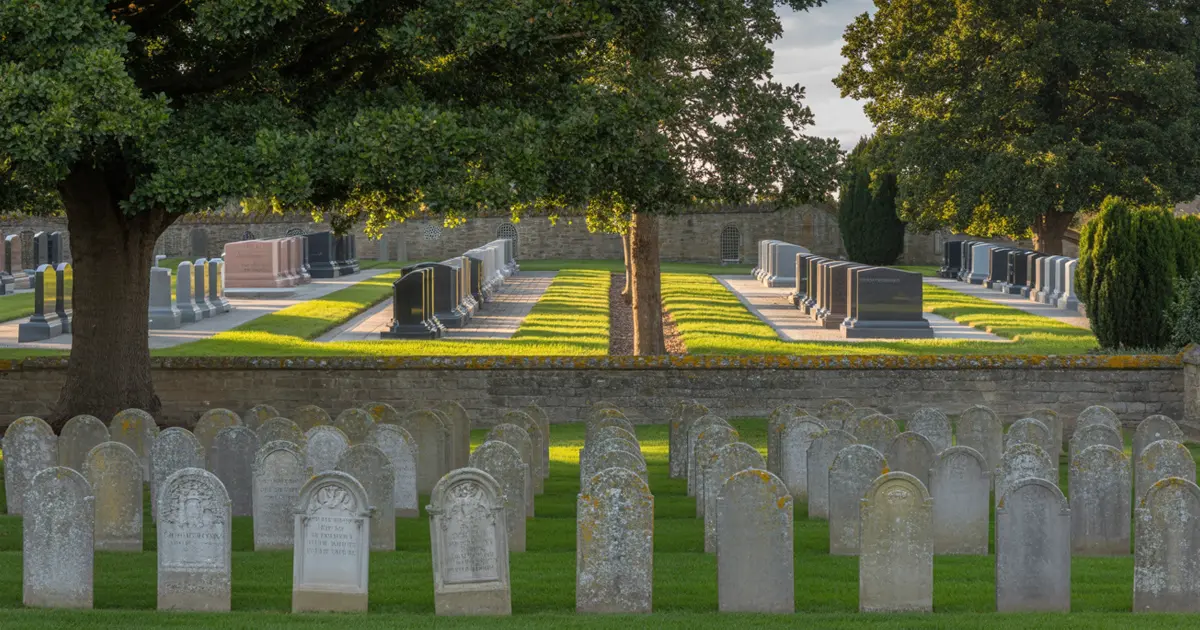
When families begin planning a headstone or memorial, one of the first surprises is discovering that the rules vary depending on where the grave is located. A design that is perfectly acceptable in a local cemetery may be refused in a churchyard, even if the burial ground is only a short distance away. Understanding why this happens can save time, reduce stress, and help you make choices that will be approved first time.
The two rulebooks: churchyards and cemeteries
In England, memorial regulations fall into two main categories:
- Churchyards are consecrated ground under the jurisdiction of the Church of England. Memorials here must comply with diocesan regulations. In the Diocese of Lincoln, this means the parish priest may only approve a memorial if it fits the published rules. Anything outside those rules, such as a polished black granite stone or a heart-shaped design, requires formal permission known as a Faculty, issued by the Chancellor of the Diocese. You can read the Diocese of Lincoln’s full regulations opens in a new tab.
- Cemeteries are managed by local councils and follow civil law. The governing framework is the Local Authorities’ Cemeteries Order 1977, which gives councils the power to create and enforce their own regulations. These rules often vary between councils, and sometimes even between different sections of the same cemetery. For example, many cemeteries have both lawn sections, where kerbs are not permitted, and traditional sections, where kerb sets are allowed within size limits.
It is also worth noting that some municipal cemeteries contain consecrated sections. If the grave is in one of these, churchyard-style restrictions apply, even though the site is council-run.
What this means for families
For families, the most noticeable differences are in the materials, finishes, and designs permitted.
- Materials and finishes: Churchyards generally prefer natural, unpolished stone that blends into the rural setting, such as slate, sandstone, or limestone. Cemeteries, on the other hand, often allow polished granites and a wider range of colours.
- Design features: Churchyard rules usually restrict kerb sets, open-book shapes, photographs, and metallic paints. Inscriptions must be simple and reverent. Cemeteries may allow these features but only in certain sections.
- Sizes: The Diocese of Lincoln’s regulations, for instance, state that headstones should be between 750 mm and 1200 mm high, and 500 mm to 900 mm wide. By contrast, North Lincolnshire Council allows lawn memorials up to 1067 mm high but bans kerbs in lawn sections.
These variations explain why one family may see a memorial in a cemetery that cannot be replicated in a churchyard, even if the style is meaningful to them.
Real-world examples
- A family in Louth once requested a white polished marble headstone with a gold inscription for a churchyard burial. Under diocesan rules, polished marble and metallic paint were not permitted, so the request was declined. By switching to a honed slate with hand-cut lettering, the family created a design that was both compliant and deeply personal.
- Another family wanted a kerb set for a loved one’s grave in a council-run cemetery. Once it was confirmed the grave was in a lawn section, where kerbs are prohibited, we helped them choose a headstone and base design that still provided space for personal touches like flower containers and a vase block.
In both cases, early checks against the correct regulations saved wasted costs and disappointment.
The approvals process
One of the most common frustrations is the question of “who actually says yes”.
- In churchyards, the parish priest can approve memorials that fit the diocesan regulations. Anything outside those rules must go through the Faculty process, which can take several months.
- In cemeteries, the local council issues a memorial permit once the design and application are approved. Each burial authority publishes its own permit form and fee schedule.
Families sometimes assume they have an automatic right to place a memorial. In fact, permission is always required, whether from the parish priest, the diocesan Chancellor, or the council.
Safety standards and fixing
All burial grounds require memorials to be installed safely. The British Standard BS 8415 sets out how memorials must be tested and fixed to withstand weather and accidental pressure. Councils also commonly require masons to work to the NAMM Code of Working Practice. These standards are designed to ensure that memorials remain secure and that families are not faced with unexpected safety issues in years to come.
Unfortunately, there have been cases across the UK where councils have laid down memorials during safety inspections, leading to upset among families. Good practice, according to the Ministry of Justice opens in a new tab, is to carry out risk-based inspections every five years and use temporary supports where necessary. Choosing a qualified, accredited mason gives families peace of mind that their memorial is installed to the correct standards and is less likely to be flagged as unsafe.
Practical tips for families
- Check the type of burial ground before choosing a design. Ask whether your loved one’s grave is in a churchyard, a consecrated cemetery section, or a lawn cemetery plot.
- Read the right regulations. Churchyard rules are published by the Diocese, while cemeteries each have their own regulations and permit forms.
- Confirm sizes and materials before falling in love with a design. Restrictions are stricter in churchyards.
- Allow for approval timeframes. Straightforward churchyard memorials can be approved quickly by the parish priest, but anything outside the rules requires a Faculty, which takes longer. Council permits are generally faster but still take time to process.
- Use a qualified fixer. Always choose a mason who works to BS 8415 and the NAMM Code. This protects your investment and avoids future problems during safety inspections.
Why choose an expert Memorial Mason
Understanding and navigating these rules can be daunting, especially when families are still grieving. At Lincolnshire Memorials, we handle all applications and approvals on behalf of our clients. We work within the regulations from the outset, provide designs that will be accepted first time, and install memorials to the highest safety standards.
This approach not only avoids costly mistakes but also ensures that the final memorial reflects your wishes in a way that is both compliant and lasting.
Questions Families Often Ask About Memorial Rules
Why Are Memorial Rules Stricter In Churchyards Than In Cemeteries?
Churchyards are consecrated ground and fall under the Church of England’s regulations, which focus on maintaining a uniform, natural setting. Cemeteries are managed by councils, so their rules are broader and often more flexible.
Can We Have A Polished Black Granite Headstone In A Churchyard?
Polished finishes are generally not permitted in churchyards under diocesan rules. A honed finish or natural stone such as slate or limestone is usually preferred and more likely to be approved.
Are Kerb Sets Allowed On All Graves?
No, many council cemeteries ban kerbs in lawn sections to make maintenance easier. They are often only allowed in designated traditional sections, and churchyards typically do not allow them at all without special permission.
How Long Does It Take To Get A Memorial Approved?
If the memorial design fits the rules, churchyard approval can often be given by the parish priest within weeks, while council permits can also be processed fairly quickly. If a Faculty is required for a churchyard memorial, the process may take several months.
Can Photographs Be Added To A Headstone?
Most dioceses do not allow photographs in churchyards, although a Faculty application may be made in special cases. Many cemeteries do permit photographs or ceramic portraits, but the final decision depends on the local council’s regulations.
Is It Possible To Add More Inscriptions Later?
Yes, additional inscriptions are usually permitted but must match the original style, lettering, and layout. Approval is required again from the parish priest, Chancellor, or council before the work can be carried out.
What Happens If A Memorial Is Found To Be Unsafe During An Inspection?
Burial authorities are required to make safe any memorials that pose a risk, which may involve staking or laying them down. Families are normally contacted and given the option to arrange compliant repairs through a qualified mason.
